Ravelist — designing a trust-first music discovery system
to help users make fast and informed decisions in high-density cities like Berlin.
Industry
Entertainment
Duration
2-3 weeks
Role
Concept, UX/UI, Systems Design, Development (AI)
Tools
Codex, Figma, ChatGPT, Claude Code, FigJam
Overview
Ravelist is a mobile-first web app for electronic music discovery in high-density cities like Berlin.
The product focuses on a single high-value moment:
helping users decide where to go this weekend—quickly and with confidence.
Instead of building a comprehensive event database, Ravelist is deliberately narrow:
curated Berlin club events
audio-assisted decision-making
high-trust, human-validated data
This shift—from aggregation to decision support—became the defining principle of the product.
Background
Berlin offers an overwhelming number of electronic music events every weekend, but existing platforms fail at the most critical moment: helping users decide where to go. While platforms like Resident Advisor provide extensive listings, they don’t communicate what an event will actually sound like or feel like.
As a result, users rely on a fragmented workflow—browsing events, searching DJs individually, and jumping between SoundCloud or YouTube. This creates friction, slows down decision-making, and makes it difficult to confidently choose an event.
The core issue is not missing data, but a lack of usable, trustworthy context at the moment of decision.
Outcome
Ravelist reframes event discovery as an audio-assisted decision experience. Instead of maximizing coverage, the app focuses on a curated set of relevant weekend events and enriches them with a small number of high-quality, playable DJ sets.
Users can quickly understand the vibe of an event without leaving the app, compare options in seconds, and make confident decisions. The system is designed around trust: only high-confidence data is published, while uncertain matches are reviewed or withheld.
By prioritizing clarity over completeness, Ravelist transforms event browsing into a fast, reliable decision flow.
Product Reframe (Core Insight)
The most important shift was redefining success.
Initial direction
Aggregate events and attach as many DJ sets as possible
Final direction
Help users confidently choose an event this weekend
This led to key principles:
confidence > coverage
events remain valid without full metadata
audio previews support decisions, not completeness
absence is better than false certainty
Ravelist became a curated, high-trust weekend guide—not a database.
Product Decisions
1. Weekend-first scope
Nightlife decisions are time-boxed. Focusing on a single upcoming weekend creates clarity and enables stronger curation.
2. Curated club set
Initial scope narrowed to a small set of high-signal Berlin clubs (e.g. Berghain, Tresor, RSO), creating a credible MVP instead of a diluted global product.
Trust over coverage
If no reliable source exists, the event is not shown. Missing data is acceptable; incorrect data is not.
Club-first sourcing
If no reliable source exists, the event is not shown. Missing data is acceptable; incorrect data is not.
2–3 strong previews per event
A few high-quality signals outperform full but unreliable coverage.
UX Exploration & Prototyping
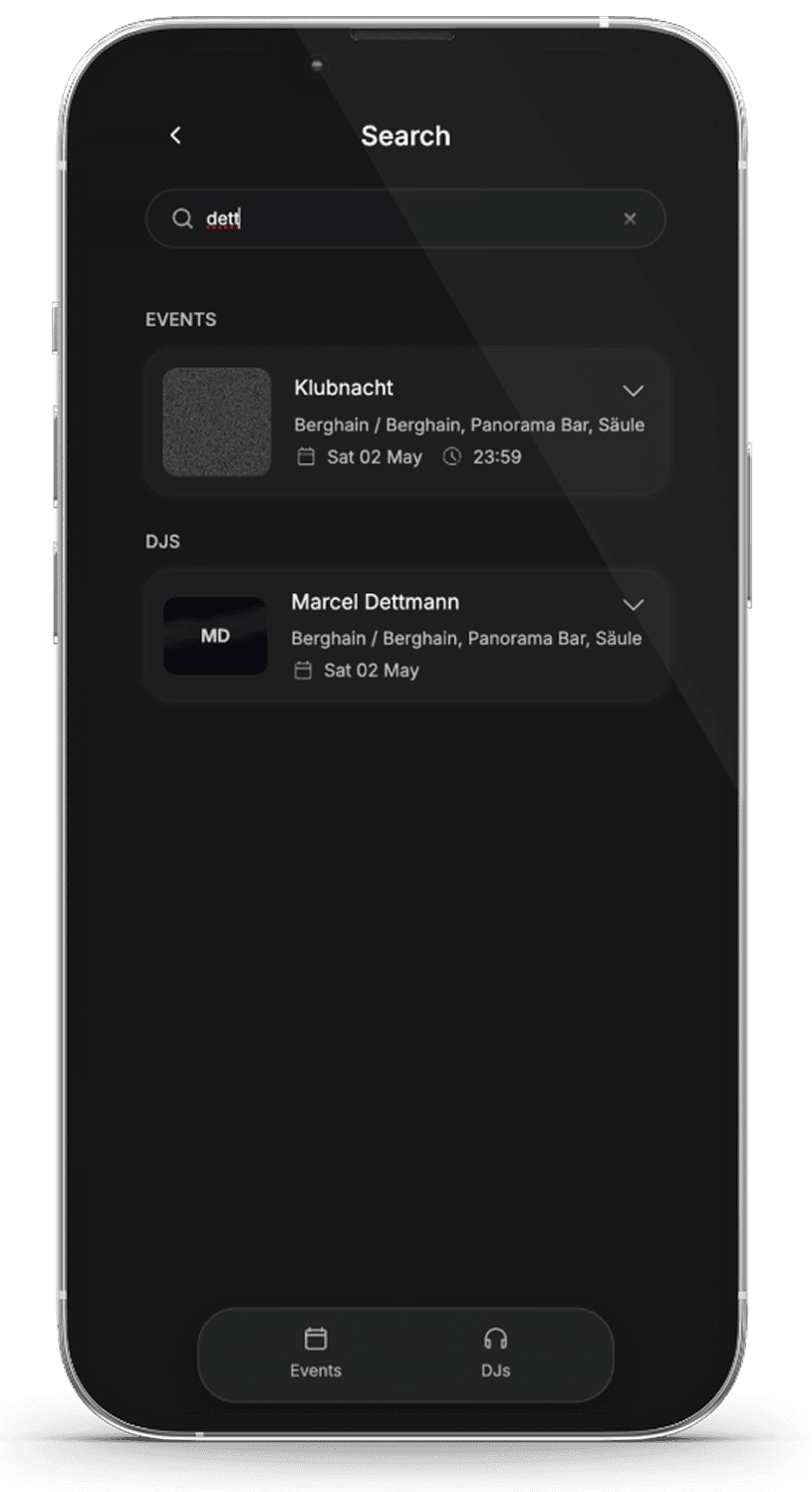
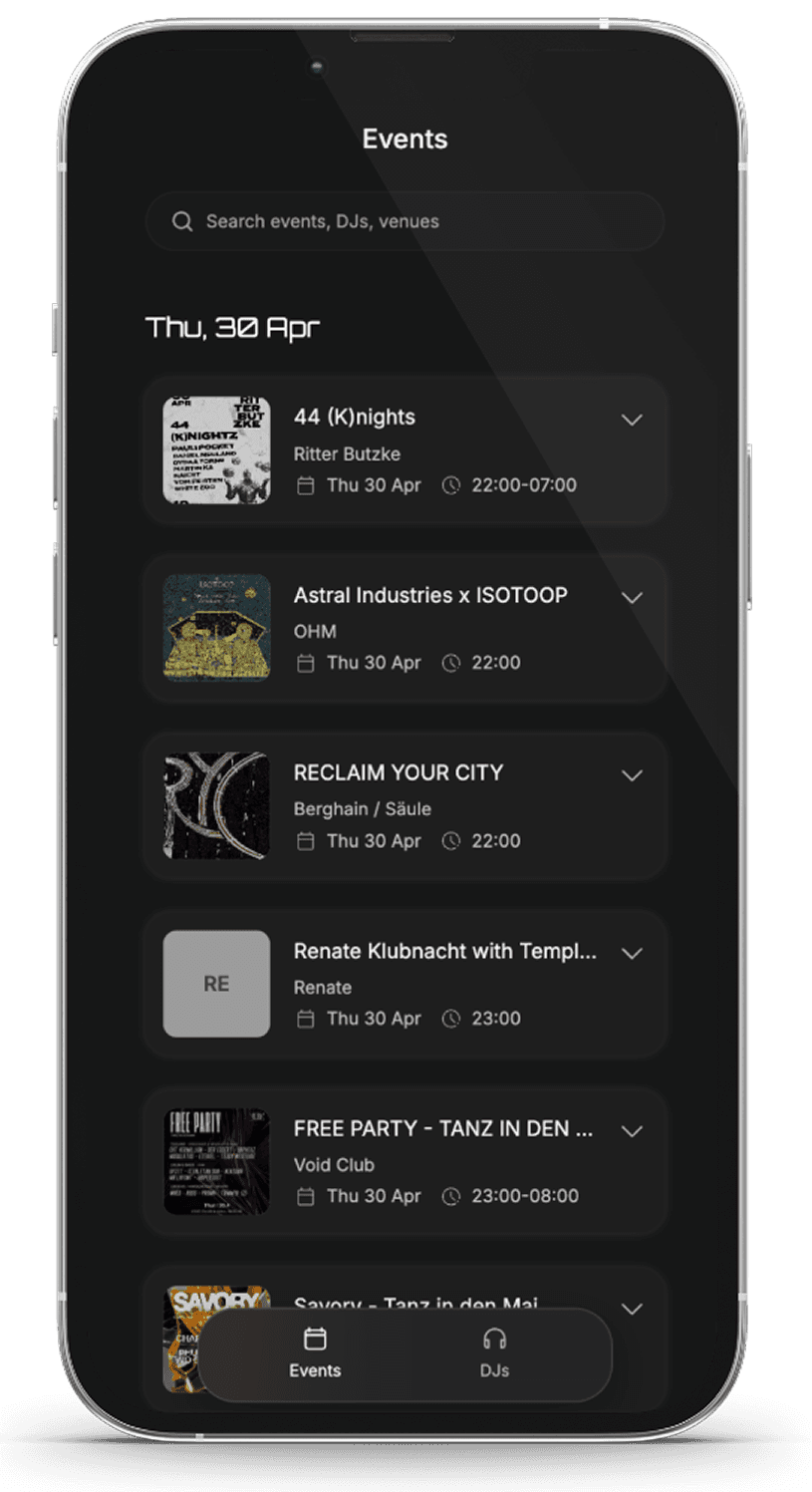
A Figma prototype was used to validate the interaction model before development.
The UX focused on:
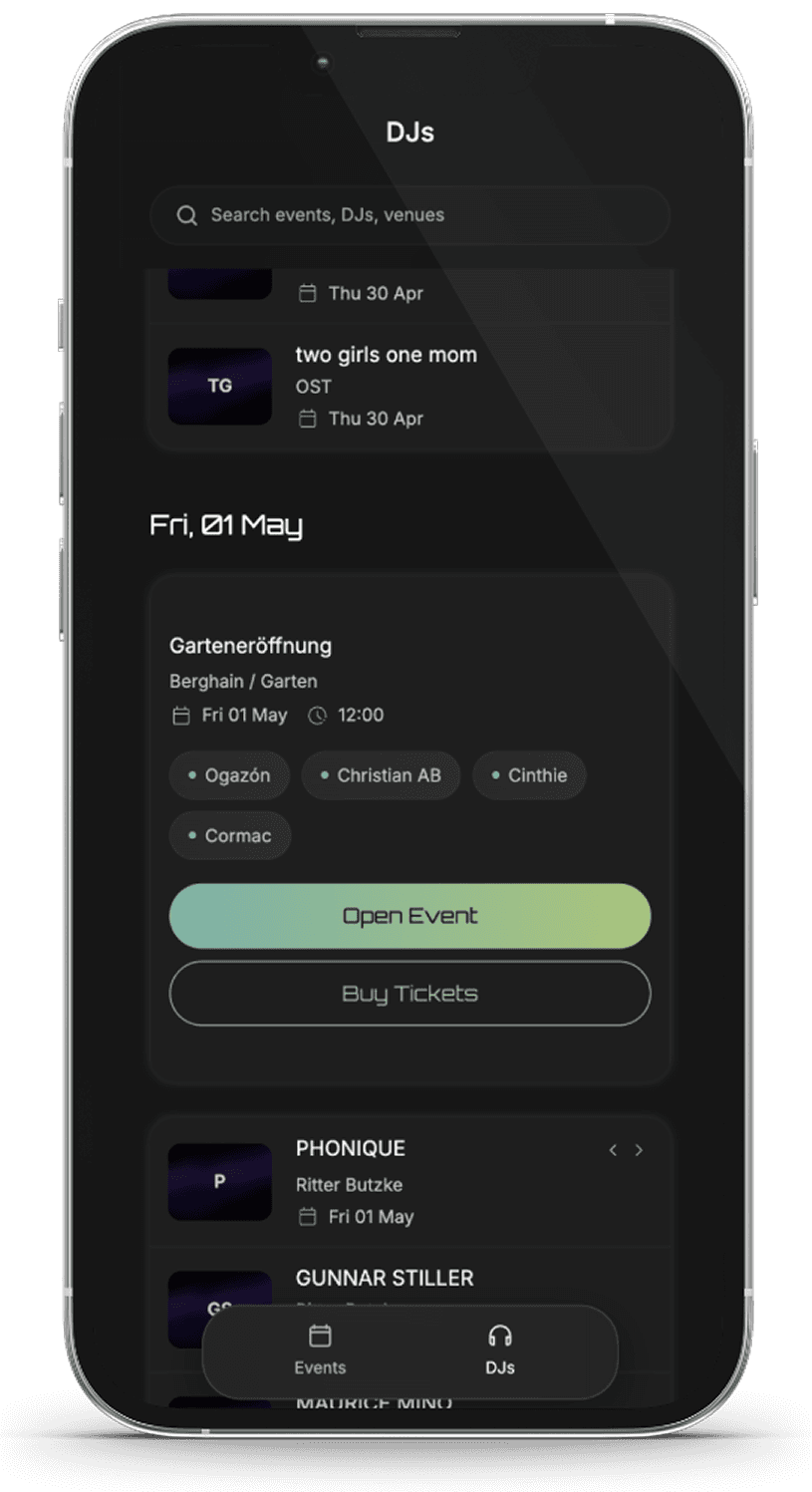
event-first discovery
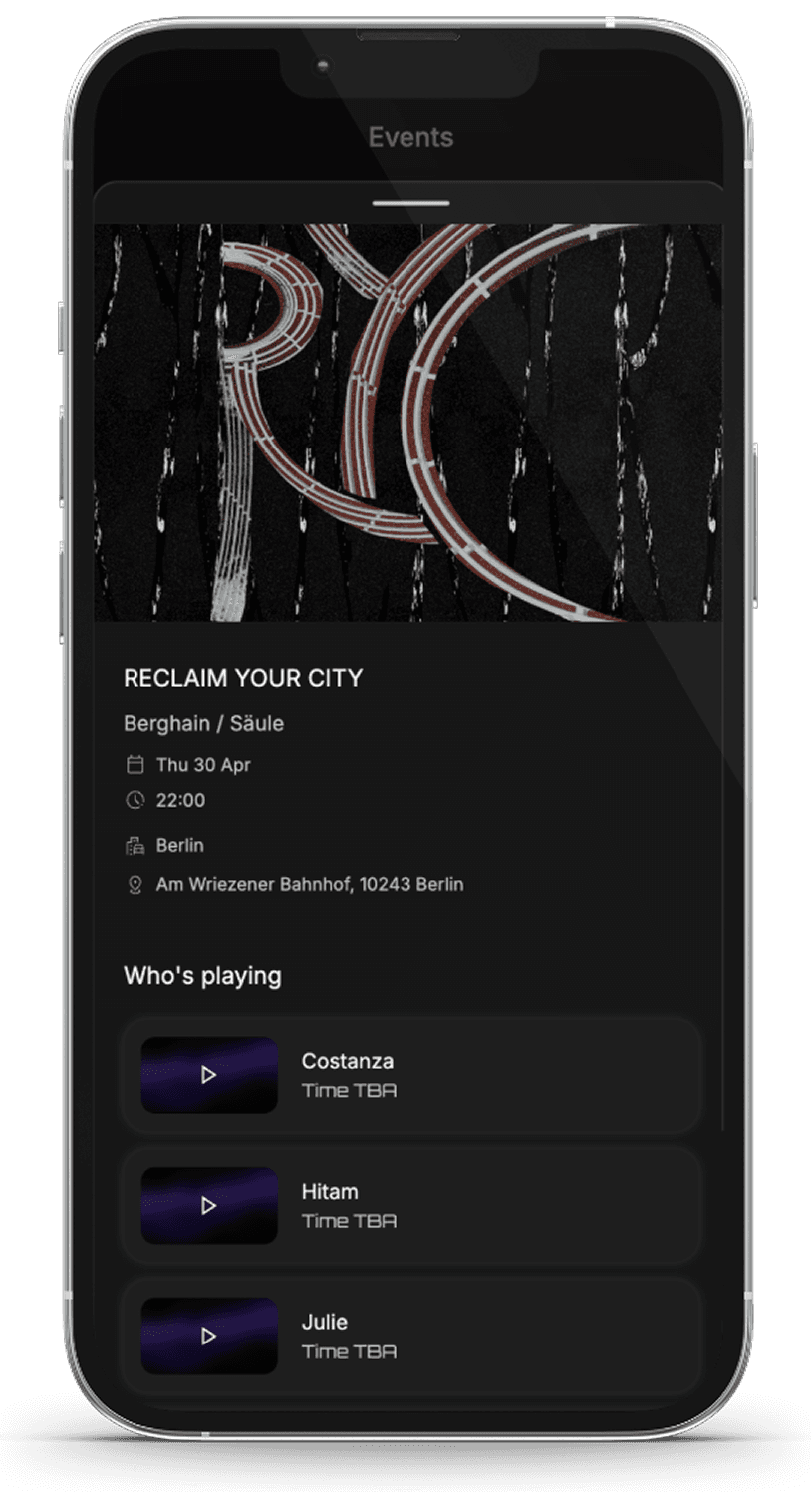
bottom sheet navigation (context-preserving exploration)
fast comparison between events
integrated long-form audio playback
The key goal was to maintain flow: users can browse, listen, and compare without losing context.
System Architecture
Ravelist is built as a modular pipeline designed for data quality and controlled exposure:
Ingestion
Collects data from trusted sources
Normalization
Creates canonical event and lineup models
Matching
Generates audio candidates
Review
Validates uncertain data
Projection
Publishes clean, user-facing views
Key insight: separate raw data from published product truth. This ensures flexibility in the backend while maintaining a clean, trustworthy frontend.
Audio Strategy
Audio is treated as a decision tool, not a content platform:
SoundCloud is the primary playback source (long-form sets, reliable embeds)
YouTube is fallback only
Playback is intentional, not ambient
The goal is simple: give users enough signal to decide, not to consume endlessly
Matching Strategy (Core Complexity)
Matching artists to relevant audio is the hardest problem in the system.
Challenges include:
Ambiguous artist names
Aliases and collectives
B2B sets
Inconsistent metadata
The system evolved from automation-first to a review-first approach:
Generate candidate matches
Apply strict filtering
Score confidence
Auto-attach only high-confidence results
Send uncertain matches to review
Key principle:
Precision over recall.
A wrong match damages trust more than missing data. This turns matching into a human-in-the-loop system, not a purely automated one.
UX System & Interaction Model
Matching artists to relevant audio is the hardest problem in the system.
The UX is designed for fast, contextual decision-making:
Event-first browsing
DJs grouped by event
Bottom sheets instead of deep navigation
Inline playback without losing context
Important nuance:
DJs are always visible—even without previews
Playback appears only when reliable
Multi-Source Strategy
To reduce dependency and increase reliability:
Primary: official club pages
Secondary: Resident Advisor (reference + tickets)
Fallback: manual curation
This introduces editorial control as a system feature, not a workaround.
AI-Driven Development Workflow
The project used a multi-agent AI workflow:
ChatGPT
Product strategy, framing, decisions
Codex
Implementation, testing, iteration
Claude
Critique, refactoring, validation
The AI workflow consists of a feedback loop that runs in circles: strategy, prototyping, implementation, critique, testing, refinement.
The key insight:
Value came from orchestration, not automation.
AI acted as a team multiplier, not a replacement.
Challenges & Constraints
01
RA blocking forced a shift away from aggregator dependency.
02
Matching artists, events, and audio reliably is inherently ambiguous.
03
YouTube unreliable; SoundCloud API constraints required fallback strategies.
04
Missing times, duplicate listings, inconsistent naming required robust normalization.
Technical Implementation
Modular ingestion pipeline with canonical data model
Projection layer for frontend performance
Semi-automated matching with review workflows
Mobile-first UI with integrated audio player
Local-first persistence and mocked services for MVP
My Role
UX/UI
Systems Design
End-to-end
Development
My work included:
Website and booking-flow audit
Problem framing based on analytics and flow analysis
Information architecture restructuring
Restructuring and renaming of service offers
Booking-flow redesign across multiple entry points
Mobile-first responsive UI design
Brand system updates including color and type
Developer handoff notes and implementation guidance
Outcome
The MVP delivers:
Curated Berlin weekend event feed
Structured event and lineup data
Playable DJ set previews
Internal review workflows
Fast, mobile-first exploration
A high-trust decision system, not just an event listing app
What I Would Do Differently
The main improvement would be earlier scope narrowing:
Define curated weekend MVP from the start
Avoid early exploration of full automation
Introduce review-first matching earlier
Design around real-world data limitations earlier
Next Steps
Expand trusted club sources
Improve audio candidate ranking
Refine player UX
Test with real users
Scale to additional cities while maintaining curation model